Most roof inspections in Delaware, New Jersey, and Pennsylvania run between $150 and $400. That is the short answer, and for a standard pitched residential roof it holds up most of the time. Plenty of contractors, us included, will do the same inspection for nothing under the right circumstances. The longer answer involves what kind of inspection you are actually buying, whether you need a signed certification on top of it, and who in a real estate deal is expected to pay.
What’s the Average Roof Inspection Cost?
Before the numbers, one caveat, because it matters more here than in most cost guides: contractors quote inspections so differently that national averages and local quotes often describe different products. Some are pricing a twenty-minute ladder look. Some are pricing two hours on a roof plus a photo report. Averaging those together produces a figure that is true and not especially useful.
With that said, the most widely cited national figure comes from Angi’s 2026 roof inspection cost data, which puts the average roof inspection cost at $252, with most homeowners paying between $125 and $383 and the full spread running from $75 all the way to $1,150. HomeAdvisor publishes the same set of figures.
Those published averages sit a little above what we typically see quoted around here for the same work, and we are not going to paper over the gap. National aggregators pull from every market in the country, including metros where an hour of skilled labor costs roughly double what it does in Kent County. Our own $150 to $400 range reflects what local homeowners actually get billed. If you are somewhere else in the US, the Angi number is probably the better anchor. If you are in our service area, the local range is.
What Actually Drives the Price
Roof complexity matters more than square footage in most cases. A 1,200-square-foot ranch is going to cost less to inspect than a 3,500-square-foot colonial with multiple dormers, valleys, and a steep pitch. Pitch and accessibility are the two things that add time on the roof, and time on the roof is what you are paying for. A single-story walkable roof might take 30 minutes. A three-story roof with a 10/12 pitch and no safe ladder access can take twice that, plus rigging.
Number of stories plays into that too, mostly through access and safety equipment rather than the inspection itself.
Does roof material change the price?
A little, mostly through how long the walk takes and how carefully the inspector has to move. Asphalt shingle roofs, still the bulk of what we inspect, are the baseline for that $150 to $400 range. Metal and synthetic roofs inspect quickly since there is less individual material to check piece by piece. Tile and slate take longer, partly because the inspector has to be careful not to crack anything underfoot, and wood shake needs a closer look for splitting and moss. Flat and low-slope roofs are their own category; membrane seams and ponding water are what we are checking there, not shingles, and that inspection prices differently than a pitched residential roof. None of this usually pushes a typical house outside the general range. It nudges you toward the top or the bottom of it.
Inspector certification level factors in too, though it shows up more in the value than the price tag. A GAF Master Elite contractor charging the same $200 to $400 as a less experienced inspector is still the better deal, because they will catch things the other person misses.
Commercial roofs are a different conversation entirely. Different buyer, different scope, different math, since commercial roof inspection cost scales with footprint and the access equipment needed rather than with anything you would recognize from a residential quote. A strip mall or an apartment building gets quoted on its own once we know what we are looking at, and nothing on this page will give you a useful number for one.
Cost by Inspection Type
| Inspection Type | Typical Cost |
|---|---|
| Basic visual inspection | $100–$200 |
| Physical / hands-on inspection | $200–$400 |
| Drone inspection | $150–$350 |
| Infrared / thermal scan | $300–$500+ |
| Satellite / remote imagery review | Not commonly priced separately in our market yet |
The $150 to $400 range at the top of this page covers the physical, hands-on inspection most homeowners actually book. A bare visual walk-through from a ladder runs cheaper, which is why it sits lower on the table.
Hands-on is what we do as standard practice, and it is what we would push you toward for anything pre-purchase or damage-related. The inspector is on the roof: touching materials, lifting shingle edges, checking for soft decking by feel. You cannot feel a soft spot in the decking from a ladder, and no drone footage tells you that either.
Drone work has gotten much more common over the past couple of years and the imagery is genuinely useful, especially on roofs that are dangerous to walk, so we use it as a supplement when the geometry calls for it. Infrared and thermal scanning finds moisture trapped under the surface without opening anything up, which is exactly what you want when there is a leak with no visible source and exactly what you do not need for a routine annual check. A roof leak inspection cost usually lands in that infrared band for that reason, assuming the source is genuinely hidden. If the leak is a cracked pipe boot, and it usually is, a standard inspection finds it and you have spent nothing extra. Satellite review is starting to appear in some markets for high-level triage. Pricing for it has not settled and we would not make a repair decision from it.
What a Roof Inspection Costs by Region
Regional variation is real but smaller than people expect. Labor rates and how competitive the local roofing market is do most of the work; the inspection itself takes about the same amount of time in Wilmington as it does outside Allentown.
New Jersey
Another New Jersey roofing company, Waynes Roofing, publishes a 2026 NJ price guide putting inspections in the $150 to $400 band, which matches what we see. Worth saying that is a competitor’s published figure rather than ours, though it is reassuring when two companies who have never spoken land on the same number.
Pennsylvania
Philadelphia runs higher than the rest of the state, which will not shock anyone. Homeyou’s Philadelphia cost page reports an average of $348 to $498 there, with the full range stretching from $121 to $970 once you fold in pre-purchase, storm, and commercial work. Standard residential inspections cluster in the $150 to $400 sub-band inside that spread. Get out to the suburbs and the collar counties and the numbers come back down toward the regional norm.
Delaware
No independent source publishes a Delaware-specific inspection figure that we would trust enough to quote. The general $150 to $400 Mid-Atlantic bracket applies, and our own experience in the state matches it. If you are already past the inspection stage and thinking about a full tear-off, our Delaware roof replacement cost guide has actual per-square numbers.
Maryland
Figures not yet available. We looked, and no third-party source publishes a Maryland roof inspection price we can point you at. Rather than make one up by averaging the neighbors, we would rather say so. Ask two or three local contractors for a number and you will have better data than this page can give you.
Roof Certification Cost: 2-Year vs 5-Year
A roof certification is a different animal from a standard inspection, even though the on-roof work looks nearly identical. Instead of a general condition report, you get a signed letter estimating the roof’s remaining service life, usually written as a 2-year or 5-year certification. Lenders ask for them on some mortgages. Insurers ask for them on older roofs before writing or renewing a policy. Buyers and sellers ask for them to settle an argument about how many years are left.
The insurance angle is the one most homeowners run into first. The NRCIA’s guide to roof certification for homeowners insurance explains the basic test: a roof has to be leak-free with two to five years of useful life left to be certifiable at all, and insurers may require that certification before issuing or renewing a policy on an older roof. That second part catches people off guard. You do not go looking for a certification. Your carrier tells you to get one, usually with a deadline attached.

On price, published numbers vary more than they should. One contractor’s published breakdown of roof certification costs gives an average of $75 to $200, then separately quotes $175 for a 2-year certification and $295 for a 5-year. Those two statements do not really reconcile with each other, and we have seen enough local quotes in the $75 to $200 zone to think the lower band is closer to normal here. Treat the longer certification as the more expensive one and expect to pay somewhere in the low hundreds. That is genuinely as precise as we can be without quoting your specific roof.
Not every roofer will issue a certification even if they will happily do the inspection. It is a liability thing, and the certified roof inspector cost reflects that they are putting their name on a signed document rather than a spoken opinion. Call ahead and confirm the company does certifications before you book, instead of finding out on site that you need a second visit from somebody else. Also ask whether the quoted price includes the letter or just the walk-through, because some outfits bill those separately and that is a bad surprise to have after the ladder is already up.
Who Pays for the Roof Inspection When a House Is Changing Hands
Convention, not law, so your agent may tell you something different for your market. In most transactions the buyer pays for the general home inspection, and that inspection includes a look at the roof, though not a deep one. HomeLight and Angi both describe it the same way: buyer pays, because the inspection exists to protect the buyer’s decision.
Where it flips is the pre-listing inspection. A seller who wants to know what a buyer’s inspector is going to find, and fix it first, pays for that one themselves. It is a strategic spend rather than an obligation. Nobody is going to make a seller do it.
The situation that actually causes arguments is the third one, where a general home inspector writes something vague about the roof and recommends a specialist. Now you need a dedicated roof inspection during the option period and neither side budgeted for it. There is no convention here. We have watched it get paid by the buyer, by the seller as a goodwill gesture, and split at closing, and we have also watched deals stall for a week over what amounts to two hundred dollars. If you are the buyer, just pay for it and get your own answer. You will be the one living under that roof.
Are Roof Inspections Ever Free?
Often, yes. Reputable roofing contractors, us included, offer free inspections when there is a reasonable chance you will need work done. That sounds transactional and it is, but it works from your side too. If a storm just rolled through, or there are water stains on your ceiling, or the roof is 18 years old and you want to know where you stand, a good contractor will come look at no charge. We do it across our whole service area with no obligation attached, and if your roof is fine we will say so. That outcome is better for us anyway. Happy homeowners refer their neighbors.
Free inspections normally apply after storm damage, when you are getting ready to list, before you close on a purchase, or once the roof ages into the window where problems start showing up. Asphalt shingles in our region last roughly 20 to 30 years depending on the product, the install, and the ventilation, and if yours is in that window a baseline inspection is worth having. Our breakdown of how long roofs last by material gets more specific by roof type. Visible problems from the ground count too: curling shingles, granule loss in the gutters, a section that looks like it is sagging. Those are signs you may need a new roof and they are worth checking rather than watching.
One thing we will say bluntly about free inspections from companies you have never heard of. After every major storm, trucks with out-of-state plates start working the neighborhoods. Some of those crews are legitimate. Many are not. Storm chasers find damage whether it exists or not, file inflated claims, do mediocre work, and are gone by the time the problem surfaces. We have repaired a lot of those roofs, and the tell is almost always the same: beautiful new shingles over decking nobody ever looked at. Be skeptical of anyone who knocks on your door unsolicited right after bad weather.
What a Real Inspection Actually Covers
Our inspections follow a 14-point checklist. Not every company works that way. Some show up, walk the roof for ten minutes, and hand you a vague verbal summary, which is not an inspection so much as a visit.
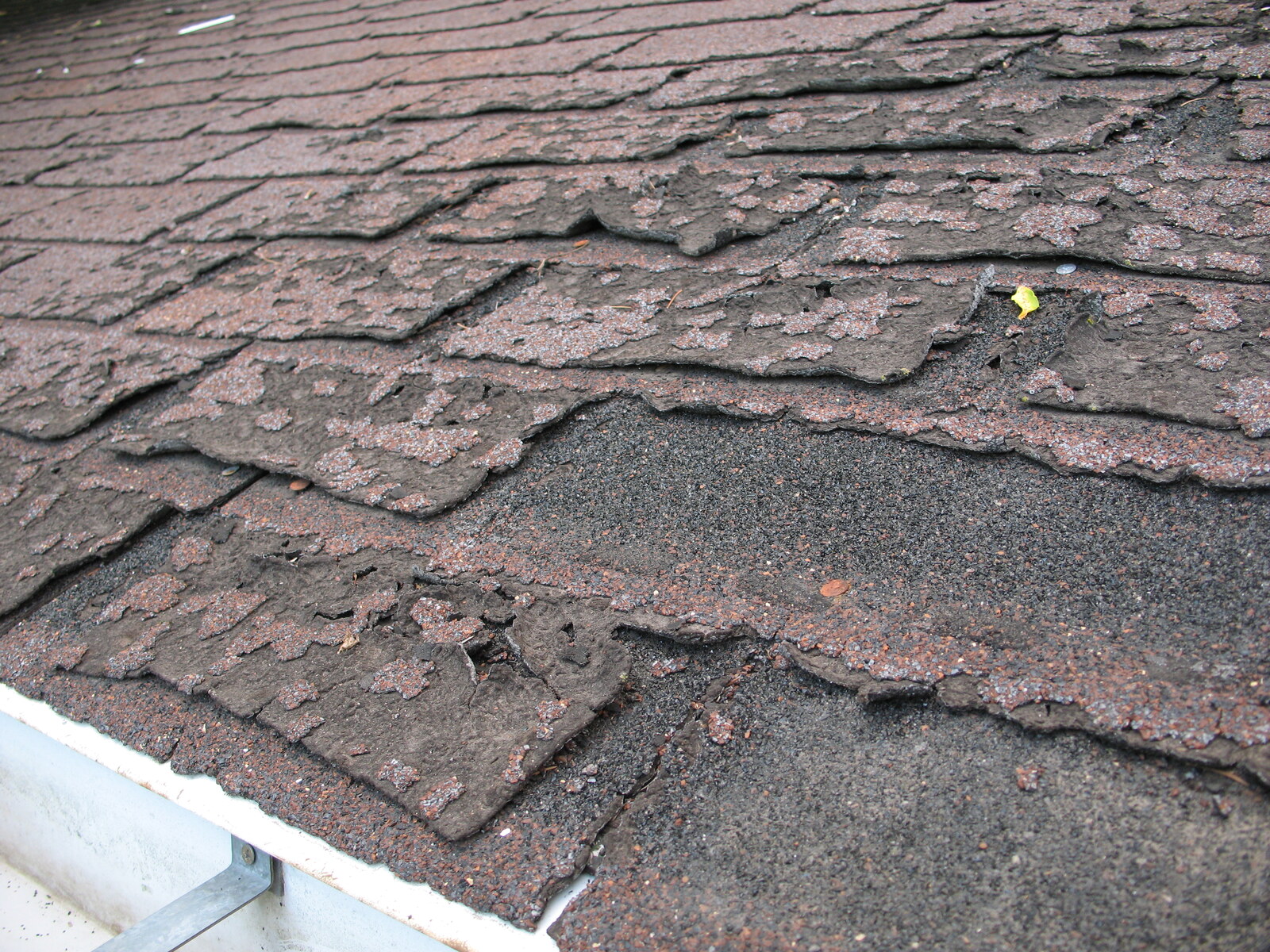
What we check: shingle condition, meaning cracking, curling, blistering, missing pieces, and the manufacturer and rough age where we can identify them; flashing integrity around chimneys, vents, skylights, and walls, since flashing failures cause a disproportionate share of leaks; ridge and hip caps; gutters and their attachment; soffit and fascia; attic ventilation at both the intake and the exhaust, because bad ventilation voids manufacturer warranties and ages shingles fast (we have seen 25-year shingles fail at 12 because of it); attic insulation where we can reach it; decking condition from the attic side, meaning soft spots, staining, or visible rot; valleys; drip edge; the quality of previous repairs, since tar patches everywhere tell us somebody already tried to fix something and probably did not; and an overall structural read for sagging ridgelines or uneven planes.
Pipe boots get their own paragraph, because they matter far more than their place in that list suggests. The rubber collars around your plumbing vents deteriorate faster than anything else up there. In roughly 70% of the leak calls we take, a cracked pipe boot is the culprit. It is a fifteen-dollar part that fails quietly over years while homeowners chase a mystery leak across three rooms and two ceilings. If you take one thing away from this page, go look at your pipe boots. They are the small rubber sleeves where the white PVC pipes come through the roof. Cracked, or pulling away from the shingle, and you have found your leak. I have a slightly unreasonable opinion about this: pipe boots should be replaced on schedule the way you replace a water heater anode, not left in place until they fail, and the industry’s habit of treating them as a repair item rather than a maintenance item costs homeowners real money in drywall.
Afterward you get a written report with photos of every issue, labeled and explained. If repairs are warranted, an estimate comes within 24 hours or on the spot. If the roof is in good shape, we tell you when to come back.
Choosing the Right Inspector
Use a licensed, insured roofing contractor rather than a handyman or a general home inspector for anything roof-specific. Beyond that, look for manufacturer certifications: GAF Master Elite covers the top 2% of contractors nationally and requires ongoing training, real insurance, and a track record. That matters for an inspection specifically, because someone who installs at that level recognizes early-stage flashing failure and marginal decking that a less experienced eye reads as fine.
Red flags are the usual ones: no physical business address, no proof of insurance, payment demanded up front, pressure to sign the same day.
What Happens After
Three outcomes, realistically. The roof is fine, so you file the report and book the next check in a year or two. Minor repairs are needed, which usually means cracked boots, a few missing shingles, or some flashing work, and a few hundred dollars spent now instead of several thousand later. Or you are at end of life, in which case replacement pricing is its own conversation and your homeowners policy may cover part of it if a storm contributed.
If you would rather have a number than a report, skip ahead and request a free quote and we will get somebody out.
FAQ
How much does a roof inspection cost on average? Between $150 and $400 in our area, with the national average sitting at $252 per Angi’s 2026 data. Many contractors do them free.
Is a roof inspection free? Ours are, in the situations described above, and a lot of reputable companies work the same way. No charge, no obligation to hire us afterward. The catch, if you want to call it one, is that we hope you pick us if work is needed. There is no inspection deposit, no hidden fee, and no upsell script. If the roof is fine we would genuinely rather tell you that and have you call in five years than manufacture a repair, partly on principle and partly because this is a small enough market that the other approach catches up with you.
How much is a roof certification? Expect the low hundreds. Published figures range from a $75 to $200 average up to $175 for a 2-year and $295 for a 5-year certification, and the longer term costs more.
Who pays for a roof inspection when selling a house? If it is the buyer’s general home inspection, the buyer. If the seller orders a pre-listing inspection to get ahead of problems, the seller. A specialist roof inspection requested mid-deal is negotiable and genuinely goes either way.
How often should I get my roof inspected? Once a year, plus after major storms.
Can I inspect my roof myself? From the ground with binoculars, yes, and that is worth doing after bad weather. Walking it yourself is a different question. Falls from residential roofs put a lot of people in the ER every year, and without experience you are unlikely to catch ventilation problems or soft decking anyway. Ground-level scan, fine. Climbing up, we would push back.
What’s the difference between a roof inspection and a home inspection? A home inspection covers the whole house at a surface level; a roof inspection from a roofing contractor is narrow and detailed. General practitioner versus specialist. When a home inspector refers you out, they are not dodging, they genuinely cannot go as deep as someone who looks at roofs all day. We have read home inspection reports describing a roof as being in good condition on houses where we later found $15,000 of damage, and the inspector was not being dishonest. They were looking with different eyes and a different scope of work.
Do I need a roof inspection before buying a house? We think so, especially if the home inspector flagged anything or the roof is over 15 years old. Visual age alone tells you nothing about install quality, ventilation, or previous repairs, and inheriting a $12,000 problem with no recourse is a bad way to start in a house.
What is the 25% rule for roofing? A code concept rather than a universal rule. In many jurisdictions, if more than 25% of a roof section needs repair or re-covering in one project, code requires that whole slope to be brought current instead of patched. It surfaces most often on insurance claims where an adjuster is choosing between repair and replace. Whether it applies to you depends on your local building department and your carrier’s own guidelines, so confirm it locally.
Related: how long different roofing materials last and signs it is time for a replacement.