Your shingles get all the attention. They’re what you see, so that makes sense. But underneath those shingles is the layer doing most of the structural work, and most homeowners don’t think about it until something goes wrong.
That layer is your roof decking.
What it is
Roof decking (also called roof sheathing) is the flat material, usually wood, that sits on top of your roof’s rafters or trusses and creates the surface everything else attaches to. Your underlayment goes on it. Your ice and water shield goes on it. Your shingles go on it. Without solid decking, none of those layers have anything to grip.
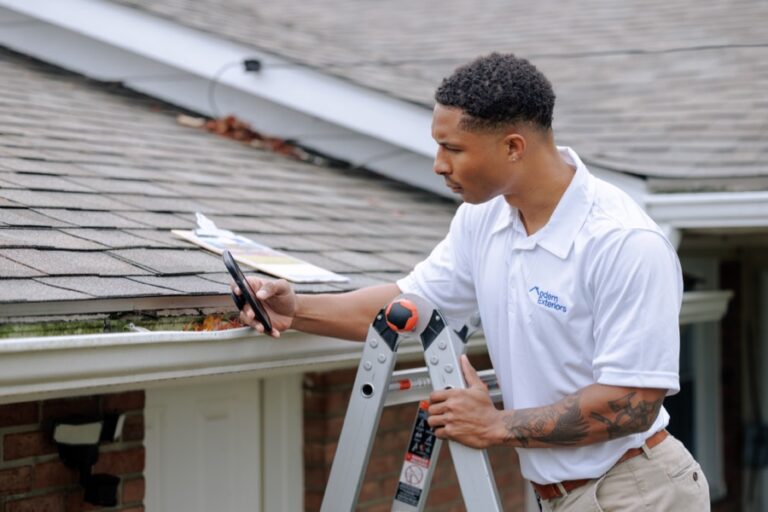
Think of it this way: your rafters are the skeleton, the decking is the skin stretched over that skeleton. It turns a series of wooden beams into an actual surface.
On most homes built after the 1970s in Delaware, New Jersey, and Pennsylvania, the decking is either plywood or OSB (oriented strand board) in 4×8-foot sheets, typically 7/16″ or 1/2″ thick. Older homes sometimes have 1×6 plank boards running horizontally across the rafters. That’s a whole different situation, which we’ll get to.
Your roof layers stack from the inside out like this:
Decking is layer two. If it fails, everything above it is compromised.
Why it matters more than most people think
We’ve torn off roofs where the shingles looked rough but the decking was fine, and the whole job went smoothly. We’ve also torn off roofs where the shingles looked okay from the ground but the decking underneath was rotted through in whole sections. The second scenario costs more and takes longer.
Three things decking does:
Structural load distribution. Your roof needs to hold its own weight, plus snow, plus the occasional person walking on it during maintenance. The decking spreads that load across the rafters. When it gets soft or deteriorated, loads concentrate on individual rafters, and things start sagging. We see this on homes in northern Delaware and South Jersey after heavy winters, usually on roofs that have been neglected for a few years past their expiration date.
Nail-holding surface for shingles. Shingles are held on by nails driven through them into the decking. If the decking is rotten or too thin, those nails don’t hold. Come the first windstorm, shingles start peeling off. Loose shingles are often a decking problem disguised as a shingle problem.
Substrate for underlayment. Your ice and water shield and synthetic underlayment need a smooth, solid surface to adhere to. Gaps, rot, and warping create spots where water can pool and seep.
Plywood vs. OSB
This is what people ask about most.
Our recommendation: plywood. Specifically, CDX plywood, 1/2″ thick or better.
Plywood
CDX plywood is made from thin layers of wood (veneers) glued together with the grain alternating direction. The “C” and “D” refer to face grades (C is the better side, D is the rougher side), and “X” means the glue is rated for exterior exposure.
It handles moisture better than OSB. Not that it’s waterproof — it’s not. But when plywood gets wet, it dries out relatively evenly and returns mostly to its original dimensions. This matters in our region. The Mid-Atlantic gets a lot of rain, and ice dams in winter can push moisture up under shingles and into the decking. Plywood is also stiffer across the same thickness. A 1/2″ plywood panel feels more solid underfoot than a 1/2″ OSB panel. Our crews notice the difference when walking a stripped roof.
The downside is cost. Plywood runs about 25-35% more per sheet than equivalent OSB. On a 2,000 square foot roof that needs full re-decking, that gap adds up.
OSB
OSB is made from wood strands pressed together with adhesive and wax. It’s been the default on new construction since the mid-1990s because it’s cheaper and comes in consistent, uniform sheets.
What doesn’t get discussed enough about OSB: it performs fine on most roofs. Perfectly fine. Millions of homes have OSB decking that’s held up for decades without any issues. The material isn’t bad.
Where OSB gets into trouble is when it gets wet and stays wet. OSB absorbs moisture along its edges, and when it does, it swells. Unlike plywood, which dries back to roughly its original shape, OSB that has swollen tends to stay swollen. You get edge swell, the panels buckle, and now you’ve got ridges showing through your shingles.
We had a job in Newark last year where the homeowner’s attic ventilation was totally inadequate. Condensation had been collecting on the underside of the OSB for years. The sheets were swollen to nearly double their original thickness at the joints. That’s an extreme case. But it illustrates exactly how OSB fails.
| Plywood (CDX) | OSB | |
|---|---|---|
| Cost per sheet | $35-55 | $25-40 |
| Moisture tolerance | Better. Dries without permanent damage. | Worse. Edge swell is permanent. |
| Stiffness (same thickness) | Higher | Lower |
| Consistency | Can have knots, voids | Very uniform |
| Our preference | Yes, when budget allows | Acceptable for well-ventilated roofs |
Those prices fluctuate. Lumber markets have been volatile since 2020, so take them as ballpark figures for our service area.
What about plank decking?
Tongue-and-groove boards (usually 2×6 pine or fir) are what you find on older homes and on roofs with exposed beam ceilings where the underside of the decking is the ceiling. Some historic homes in New Castle, DE or the older neighborhoods in Cherry Hill, NJ still have this.
We don’t recommend it for standard residential roofing. It’s expensive, slow to install, and offers no advantage over plywood for most applications. Where it makes sense is when the decking has to look good from below, like in a vaulted great room with exposed rafters.
Signs your decking needs replacing
You usually can’t see it without pulling up shingles. But there are signals.
Sagging between rafters. Go outside on a sunny day and look at your roofline from across the street. It should be straight, or follow a consistent intended curve. Dips or waviness between the rafters means something is wrong. Take a photo and zoom in — a subtle sag is hard to spot in real time.
From the attic, you can check more directly. Bring a flashlight and look for daylight showing through, dark staining or water marks on the wood, and any soft or spongy spots when you press on the underside.
The tricky part: decking can look fine from the attic side but be rotted on the top surface, especially around flashing failures and in valleys where water collects. We’ve pulled shingles off roofs that looked okay from below, only to find the top quarter inch of the decking had turned to mush. So an attic inspection is helpful but not definitive.
Funny tangent: we once did a tear-off on a split-level in Dover where someone had patched a section of decking with what turned out to be a cabinet door. Not even close to the right thickness. It had been there for at least a decade based on the shingle layers over it. The roof didn’t leak at that spot, somehow. We replaced it with actual plywood.
What replacement costs
Full decking replacement on an average-sized home (1,500-2,500 sq ft of roof area) in our service area typically runs $2,000-$6,000 for materials and labor, on top of the roof replacement itself. Wide range, and it depends on how many sheets need replacing, plywood vs. OSB, roof pitch and accessibility, and whether the existing decking is plank boards that need to be replaced with sheet goods.
Most roof replacements don’t need a full re-deck. In our experience across Delaware, South Jersey, and eastern Pennsylvania, maybe 15-25% of the roofs we replace need some decking work, and only a fraction of those need the whole thing replaced. More commonly we’re swapping out a dozen or so sheets in damaged areas.
We covered overall pricing in more detail in our Delaware roof replacement cost article, but decking work is always a line item we discuss before starting.
One note on estimates: any roofer who quotes you a firm price for decking replacement before tearing off the old shingles is guessing. We can estimate based on attic inspection, age of the roof, and what we see from outside, but the real condition isn’t confirmed until the old roof comes off. Our contracts include per-sheet pricing for decking so you know the cost if additional replacement is needed during the job. No surprises.
What about storm damage?
Sometimes.
Storm damage — a tree on the roof, hail, wind — that results in decking damage is typically covered. Normal wear and aging isn’t. If your decking rotted because your roof was 25 years old and past its useful life, that’s on you.
The gray area is when storm damage and pre-existing deterioration overlap. Say a windstorm tears off shingles, and when the roofer pulls them up, the decking underneath is half rotted from years of slow leaks. Was the damage caused by the storm or by neglect? Document everything and get a professional assessment before making decisions.
When to worry, when not to
If your roof is under 15 years old, was installed by a competent contractor, and you have no signs of leaks or sagging, your decking is almost certainly fine.
If your roof is 20+ years old and you’re starting to see warning signs, it’s time to think about the whole system, decking included. A professional roof inspection can identify decking issues before they become emergencies. The decking typically outlasts one set of shingles — it’s rare to replace decking on a 12-year-old roof unless something went badly wrong with moisture management.
FAQ
What is roof decking made of?
Most residential roof decking in the Mid-Atlantic is either plywood (CDX grade) or OSB. Older homes might have solid wood plank boards, usually 1×6 lumber. We prefer plywood for its moisture performance, but OSB works well when the attic stays dry and ventilated.
Can you put a new roof over bad decking?
No. Any contractor who offers to is someone you should walk away from.
How thick should it be?
Code minimum in most jurisdictions is 7/16″, but 1/2″ or 5/8″ is better. Thicker decking is stiffer, holds nails better, and gives you more margin against moisture damage. On homes with rafters spaced 24″ on center instead of the more common 16″, 5/8″ is really the minimum that makes sense.
How long does roof decking last?
Under normal conditions with a properly installed roof above it, plywood or OSB can last 30-50 years. For a complete overview of roofing components and how they work together, see our roofing materials guide. Sometimes longer. The decking typically outlasts at least one set of shingles.
Do you always have to replace decking when replacing a roof?
No. We inspect it during every tear-off, and if it’s solid, we leave it. Most roofs don’t need full decking replacement. We only replace panels that are damaged, soft, water-stained, or structurally compromised.
What’s the difference between roof decking and roof sheathing?
Same thing. The terms are used interchangeably in residential roofing.